How Gutter Installation Helps Prevent Ice and Water Buildup
A roof sheds more water than most homeowners realize. On a modest house, a steady rain can send hundreds of gallons down the roofline in a short stretch of time. When temperatures drop, that same water can freeze at the edges, back up beneath shingles, and create the kind of damage that does not stay neatly outside. It stains ceilings, rots fascia boards, warps trim, loosens fasteners, and can eventually affect insulation and framing.
That is where proper Gutter Installation earns its keep. Gutters are often treated like a finishing detail, something attached late in a project because the house looks incomplete without them. In practice, they are part of the water management system that protects the roof, walls, foundation, and the ground immediately around the house. When gutters are sized correctly, pitched properly, and paired with the right downspout layout, they do far more than move rain off the roof. They reduce the conditions that lead to ice buildup in winter and standing water during every other season.
The relationship between gutters, ice, and drainage is not always obvious until something fails. A home can appear fine from the driveway while a freeze-thaw cycle is quietly pushing water under shingles. Likewise, a section of gutter can look intact while it sags just enough to hold water after every storm. The damage tends to build slowly, then show up all at once.
Why roof edges become trouble spots
Ice and water buildup start with simple physics. Warmth from the home, winter sun exposure, or even attic heat loss can cause snow on the upper roof to melt. That meltwater runs downward until it reaches a colder eave. At that point, it can refreeze. Once the process repeats a few times, a ridge of ice forms along the roof edge. That ridge blocks later meltwater, forcing it to pool behind the ice barrier.
If that water stays trapped long enough, it can work its way beneath shingles and into the roof deck. Shingles are designed to shed water, not hold a pond. When water moves uphill by capillary action or gets pushed by freeze expansion, even a decent roof can be vulnerable.
Poor drainage adds another layer of risk. If gutters are clogged with leaves, roof granules, seed pods, or ice from earlier storms, the water has nowhere to go. It overflows at the front, spills behind the gutter, or remains in the trough and freezes solid. Any of those outcomes increase weight and stress at the eaves.
I have seen homes where the original roofing was still in good condition, but the fascia was soft enough to push a screwdriver into it. The cause was not failed shingles. It was years of water running behind a poorly installed gutter. I have also seen newer homes where the gutter pitch was so flat that every winter left pockets of ice sitting in the system for weeks. A few small installation errors can create conditions that repeatedly invite damage.
What proper Gutter Installation actually does
A well-designed gutter system manages flow before water can linger in the wrong places. It captures runoff at the roof edge, channels it toward downspouts, and discharges it far enough from the house to protect the foundation and reduce splashback against siding. In winter, this matters because moving water is less likely to freeze in place than water trapped in low spots.
Proper installation is more technical than many people expect. The gutter has to be set at the correct pitch, usually subtle enough that the eye barely notices it, but deliberate enough to keep water moving. Hangers need to be spaced so the gutter does not bow under water weight or ice load. Downspouts have to be placed where the roof actually produces flow, not just where they look symmetrical from the street. The gutter profile needs enough capacity for the roof area and local rainfall patterns.
When those pieces come together, the system reduces the conditions that promote ice dams and standing water. It does not eliminate every winter risk, because attic insulation, ventilation, roof geometry, and climate all matter too. Still, proper Gutter Installation often makes the difference between a manageable winter roofline and a chronic problem area.
Pitch matters more than most people think
Ask experienced installers what separates a gutter that performs well from one that constantly causes callbacks, and pitch will come up quickly. Gutters must slope enough to drain, but not so much that they look crooked or lose capacity at the high end. The margin for error is smaller on long runs, especially on front elevations where appearance matters.
A gutter that is nearly level can hold shallow pools after every storm. In warm weather, that may simply lead to algae staining or mosquito issues. In freezing weather, those shallow pools become strips of ice. Once ice forms, later runoff catches on it. The gutter gets heavier, drainage slows, and expansion can stress seams and fasteners.
I remember one house with a dramatic roofline over a front porch. The owners assumed the winter icicles were normal because the house had “always done that.” What they actually had was a long gutter run with too little fall and only one undersized downspout near the corner. Water traveled poorly even in moderate rain. In winter, that sluggish drainage turned the entire front edge into a freezing zone. After correcting the pitch and improving the downspout layout, the icicles did not disappear entirely during extreme cold, but the chronic heavy buildup stopped.
That is the practical value of getting pitch right. You are not chasing perfection. You are reducing the amount of water that lingers long enough to freeze where it should have drained.
Capacity is not just about heavy rain
Homeowners often think of gutter size only during downpours, when they see overflow spilling over the front edge. Winter performance is tied to capacity too. A gutter that is too small for the roof section can become overwhelmed by melting snow, especially during rapid warmups. When a roof dumps concentrated water into a shallow gutter, the system backs up faster and is more likely to freeze at chokepoints.
Steeper roofs, long roof planes, and valleys all increase the amount and speed of runoff entering a gutter. Metal roofs can intensify the issue because snow and ice release differently than they do on asphalt shingles. A small K-style gutter may be adequate on one elevation and marginal on another. That is why competent installers look at the whole drainage picture rather than quoting a one-size-fits-all setup.
There is also a common misconception that bigger is always better. Oversizing can help in some situations, but only if the rest of the system matches. A large gutter paired with too few downspouts can still hold water longer than it should. The best system is balanced. Capacity, pitch, hanger spacing, outlet size, and discharge all need to support each other.
The role of downspouts in preventing freeze problems
Gutters collect water, but downspouts finish the job. If the gutters are the highway, the downspouts are the exits. Too few exits, or poorly placed ones, create backups. Water stacks up in the trough, moves more slowly, and in cold weather has more time to freeze.
Placement matters because roofs do not drain evenly. Valleys concentrate runoff. Dormers create interruption points. Some sections are shaded all day in winter, while others warm up in direct sun and release meltwater sooner. A thoughtful installer accounts for these variables. A careless one spaces downspouts based on convenience.
The discharge location matters as well. If downspouts empty too close to the foundation, the problem shifts from the roofline to the base of the house. Saturated soil next to the foundation is bad enough in spring and summer. In winter, repeated freezing and thawing near the footing can contribute to heaving, cracking in walkways, and slick conditions at entries.
A complete system carries water away from the structure. That may mean splash blocks in simple situations, or extensions and underground drains where grading is poor. The point is not merely to get water out of the gutter. It is to keep it from collecting where it causes a second round of trouble.
Ice dams are not only a roofing problem
People usually call a roofer when they see interior leaks near the ceiling line. Often, that is necessary. But ice-related damage frequently starts in ways that involve several parts of the building envelope at once. The roof edge, fascia, soffit, gutter, insulation, and attic ventilation all interact.
When gutters are loose or clogged, water can spill behind them and soak the fascia. Once wood stays damp, cold weather compounds the damage. Paint fails, joints open, and rot sets in. If ice forms repeatedly at the same spots, the added weight can pull gutters away from the house, widening the gap where water gets behind them. It becomes a cycle. Poor drainage leads to moisture, moisture weakens the mounting surface, and the weakened mounting surface makes drainage worse.
I have seen soffit vents blocked by previous repairs done after water damage, which then reduced attic ventilation and made the roof surface warmer. That extra warmth increased snowmelt, which produced more edge refreezing. It is rarely just one thing. But a sound gutter system breaks part of that chain and often prevents the initial overflow that starts the cascade.
Seamless gutters and fewer failure points
Seams are natural weak points. Over time, expansion, contraction, debris, and ice stress can open joints enough to drip or leak. In climates with significant freeze-thaw cycles, this matters. Water that seeps from a seam can stain exterior finishes, encourage mildew, or freeze at connection points.
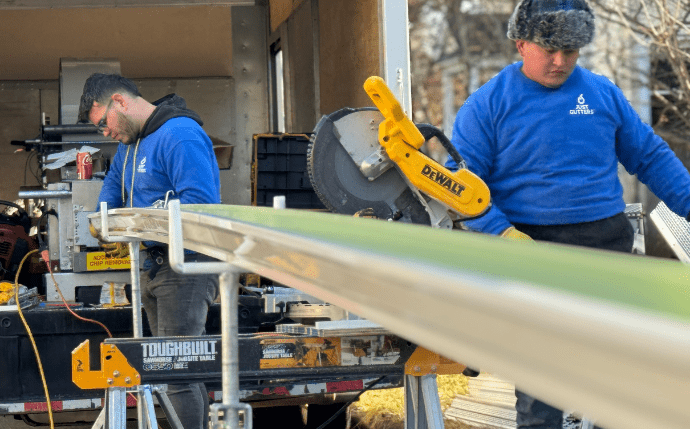
That is one reason many contractors prefer seamless gutters for long runs. They are fabricated to length on site, which reduces the number of joints and, with good installation, lowers the chance of leaks. Seams still exist at corners and outlets, so workmanship remains important, but fewer joints usually mean fewer maintenance headaches.
Material choice matters too. Aluminum is common because it resists rust and is practical for most homes. Steel is stronger but can be more vulnerable to corrosion if coatings fail. Copper is durable and attractive, but its cost places it in a different category. The best material depends on climate, budget, and architectural style, though proper installation usually has a greater effect on performance than upgrading to a premium metal while ignoring pitch and support.
Hanger spacing and structural support in winter
Ice is heavy. Wet snow is heavier than people expect. A gutter that performs fine through autumn rain can struggle once winter adds load. That is why support hardware is not a minor detail.
Modern hidden hangers, when correctly spaced and fastened into solid backing, hold shape much better than old spike-and-ferrule systems that loosen over time. If hangers are too far apart, the gutter can dip between them. Those dips become collection points for standing water. In freezing temperatures, that standing water becomes ice. The weight increases, the dip worsens, and eventually the run may twist or separate from the fascia.
On houses with long eaves, nearby trees, or a history of snow buildup, closer hanger spacing is often worth the modest added cost. It is not flashy work, but it pays off in durability. Gutters fail gradually before they fail dramatically. Better support slows both processes.
Debris control and the limits of gutter guards
Clogged gutters are one of the most predictable causes of water and ice buildup. Leaves, needles, shingle granules, and small twigs reduce flow and trap moisture. In winter, that damp debris becomes a base for ice formation.
Gutter guards can help, but they are not magic. Some perform well with broad leaves yet struggle with pine needles. Others shed debris effectively but complicate cleaning when sediment still accumulates. On certain roof types, guards can create a gap where wind-driven rain overshoots the gutter. In snowy climates, some designs also interact poorly with sliding roof snow.
A realistic expectation is that guards reduce maintenance frequency, not eliminate maintenance entirely. They work best when chosen for the surrounding tree cover and roof conditions. If a house sits under maples, the solution may differ from a house surrounded by pines. The key is matching product to site conditions rather than assuming every cover system solves the same problem.
Signs that poor installation is contributing to buildup
You do not need to wait for interior damage to spot a drainage problem. Exterior clues are often visible months or years earlier. Watch what the system does during ordinary weather, not just storms. Performance in a light rain often tells you more than performance in a dramatic downpour.
Here are some common warning signs worth paying attention to:
- Water remains in the gutter hours after rain has stopped.
- Icicles consistently form in the same section while nearby runs stay relatively clear.
- Staining appears on fascia, soffit, or siding directly below a gutter seam or end cap.
- Gutters pull away from the house, sag in the middle, or show visible low spots.
- Water pools near the foundation or freezes on walkways beneath downspouts.
Any one of these issues can point to installation defects, lack of maintenance, or both. The pattern matters. A single icicle during an extreme cold snap is not unusual. A recurring ridge of ice across the same shaded eave is a signal.
The connection between attic conditions and gutter performance
It would be misleading to suggest that gutters alone prevent every ice problem. Ice dams often begin with heat loss from the house. If warm air leaks into the attic, the upper roof warms enough to melt snow while the eaves remain cold. That mismatch drives the freeze-thaw pattern that produces dams.
Even so, gutter performance still matters. A roof with some heat loss may avoid interior leaks for years if drainage is efficient and the eaves do not trap water. The same roof can begin leaking quickly if clogged or poorly pitched gutters hold meltwater at the edge. Think of attic insulation and ventilation as reducing the amount of problematic meltwater, while gutters reduce the chance that meltwater stays where it can refreeze and back up.
This is why the best repairs often involve more than one trade. A homeowner may need air sealing or insulation work in the attic, plus gutter corrections outside. Fixing only one side of the problem can improve things, but addressing both usually produces a more durable result.
Installation details that make a measurable difference
The most reliable gutter systems are not necessarily the most expensive. They are the ones where basic details are handled well. A few decisions consistently separate durable installations from short-lived ones.
Good installers pay attention to these factors:
- Proper slope across each run, adjusted for length and outlet location.
- Adequate gutter size and downspout count for the roof area and local weather.
- Secure hanger spacing tied into solid fascia or backing, not weak material.
- Clean, well-sealed outlets and corners that do not restrict flow.
- Downspout discharge directed away from the foundation and walking surfaces.
None of those points are glamorous, and homeowners rarely compliment them the way they notice a new front door or roof color. Yet these are the details that determine whether a system sheds water quietly for years or causes repetitive repairs.
Older homes require extra judgment
Historic and older homes often present special challenges. Fascia boards may be uneven, rooflines may have settled, and decorative crown moldings can complicate mounting. Some houses were built before modern gutter dimensions became standard, so installers have to adapt without compromising drainage.
In these cases, the best work is usually a balance between preservation and performance. Sometimes half-round gutters fit the architecture better than K-style systems. Sometimes custom brackets are the right answer because standard hangers would sit awkwardly or fail to align. It is also common to find hidden rot once old gutters come off, and that needs to be repaired before new gutters go up. Installing over damaged wood only postpones the problem.
This is where experience shows. A contractor who mostly works on new subdivisions may miss the nuances of an older structure. On a century home, a technically decent installation can still be wrong if it ignores the building’s quirks.
Climate changes the right answer
A house in a dry region with occasional storms needs a different strategy than one in a snowy, wooded, freeze-prone area. In the Upper Midwest or Northeast, winter load and ice management https://israelsmxt704.zenbloomer.com/posts/the-most-durable-materials-for-gutter-installation may drive the design. In parts of the Pacific Northwest, persistent moisture and debris may matter more. In the South, oversized downspouts might be more important because intense rain events can overwhelm standard systems.
That is why national rules of thumb should be treated cautiously. Local installers who understand snow patterns, tree cover, and common failure points usually make better recommendations than generic online advice. The roof shape, not just the region, matters too. A simple ranch with open exposure behaves differently from a multistory house with valleys, dormers, and heavy shade.
Maintenance still matters after installation
Even the best gutter system needs periodic attention. Leaves collect, sealant ages, and storms can knock branches into runs. Maintenance is not a sign that the system was poorly installed. It is part of owning any drainage system exposed to weather year-round.
Most homes benefit from at least seasonal checks, especially after fall leaf drop and before the deep freeze of winter. The goal is simple: keep water moving. That means clearing debris, checking for standing water, tightening loose sections, and confirming that downspouts discharge freely.
For homeowners who prefer not to climb ladders, a yearly service call is often money well spent. The cost is small compared with repairing water-damaged fascia, interior ceiling stains, or foundation drainage issues. More importantly, regular inspection catches subtle problems before they become structural ones.
Choosing installation with prevention in mind
When homeowners compare quotes, price understandably gets attention. But the cheapest bid is often built around what is easiest to install, not what will perform best in January. If one contractor discusses pitch, hanger spacing, downspout placement, and discharge distance while another gives only a linear-foot price, that difference is meaningful.
Ask practical questions. How will water be directed away from the house? How many downspouts are planned, and why? Will existing fascia be inspected for rot before installation? How will the system handle the roof valleys? The answers reveal whether the contractor is thinking like a water-management professional or simply hanging metal along the eaves.
A gutter system is not a cure-all for winter roof problems, but proper Gutter Installation is one of the clearest ways to reduce the chance of ice and water buildup. It keeps runoff moving, limits standing water, lowers the strain of freeze-thaw cycles, and protects the vulnerable edge where roofs most often fail first. When it is designed and installed with climate, roof shape, and maintenance in mind, it quietly prevents the sort of damage homeowners tend to discover only after it has become expensive.
Just Gutters LLC
Address: 262 Main St, Hackettstown, NJ 07840
Phone number: +12013319454
FAQ About Gutter Installation Hackettstown
Can I install a gutter myself?
Yes, you can install gutters yourself. DIYers typically use aluminum or vinyl sections from home improvement stores. The project requires basic tools, precise measuring, and comfort working on ladders. Key steps include snapping a chalk line for a slight slope (1/4 inch per 10 feet toward downspouts), securing hangers every 2 feet, and caulking all joints securely.
How much does body contouring usually cost?
The Home Depot typically charges between $1,000 and $3,600 for a standard professional gutter installation on a typical single-family home with 200 linear feet of gutters. Calculated on a per-foot basis, the cost usually ranges from $5 to $18 per linear foot, highly dependent on the material you select.
How much does a 40 ft seamless gutter cost?
A 40 ft seamless gutter run will cost between $240 and $1,120+ fully installed, depending on the material you choose. Because seamless gutters require specialized on-site fabrication machines, they are rarely sold as DIY kits and are priced per linear foot.